
 5 min read
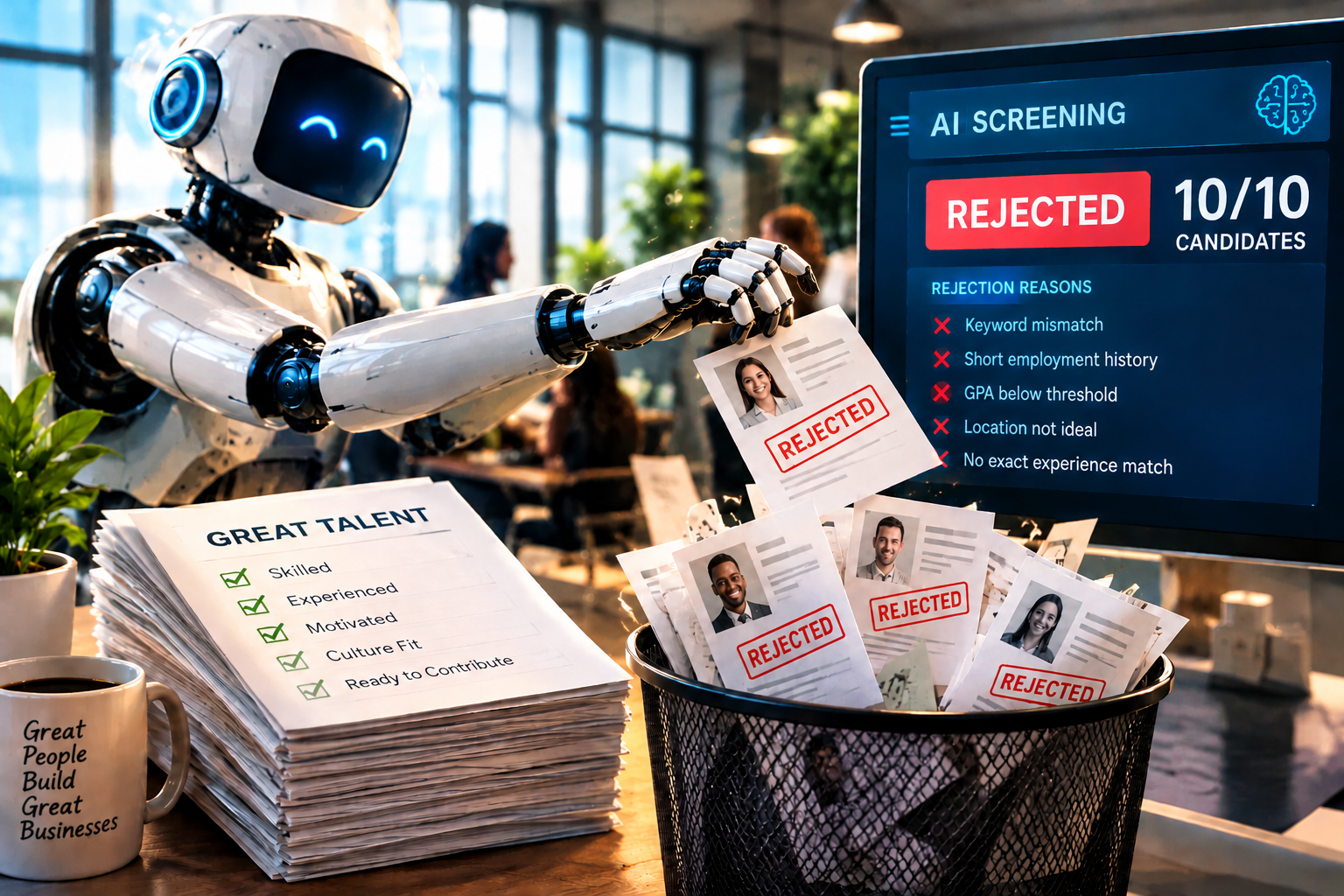
AI is rapidly becoming one of the most powerful tools in modern recruiting. It can screen resumes in seconds. Identify patterns humans miss. Accelerate sourcing. Improve efficiency. Reduce administrative overload. For HR teams drowning in applications and pressured to hire faster, that sounds like the future.
And in many ways, it is.
But there’s a growing problem few organizations are talking about openly enough:
AI hiring tools can scale bias just as fast as they scale efficiency.
And many HR teams don’t realize it’s happening until damage is already done.
The conversation around AI in recruiting has become heavily focused on speed, automation, and productivity. Those benefits are real. But organizations that implement AI without proper governance, auditing, and oversight risk creating hiring systems that quietly reinforce inequality, reduce candidate quality, and expose the business to serious compliance concerns.
The danger isn’t that AI will “replace recruiters.”
The danger is that companies will trust AI decisions they don’t fully understand.
The Illusion of Objectivity
One of the biggest misconceptions about AI recruiting tools is that algorithms are automatically neutral.
They aren’t.
AI systems learn from historical data. That means they often inherit the same patterns, preferences, and biases that existed in previous hiring decisions.
If past hiring favored certain schools, industries, career paths, or demographics, AI can unintentionally amplify those trends.
The result?
Qualified candidates may never make it into the interview process—not because they lack capability, but because the system was trained to prioritize a narrow version of “success.”
This becomes especially dangerous in industries already facing labor shortages, workforce gaps, or diversity challenges.
Manufacturing, healthcare, logistics, and skilled trades are prime examples. Organizations cannot afford to eliminate strong candidates because of flawed automation logic.
Speed Without Oversight Creates Risk
AI sourcing and screening tools are incredibly effective at processing volume. But high-volume decision-making without guardrails is where problems emerge.
HR leaders should ask difficult questions before relying too heavily on automation:
- What data was this model trained on?
- How often are outputs audited?
- Can recruiters override recommendations?
- Are rejection patterns being monitored?
- Is the system transparent enough to explain hiring decisions?
- Could certain groups be disproportionately filtered out?
If the answer to those questions is unclear, the organization may already have a governance problem.
This is particularly important as regulations around AI hiring practices continue evolving across the U.S. and globally. Transparency, fairness, and explainability are becoming legal expectations, not optional best practices.
The Best HR Teams Use AI as an Assistant, Not a Decision-Maker
The organizations getting AI right are not removing humans from the process.
They’re using AI to enhance human judgment, not replace it.
That distinction matters.
Strong recruiting teams use AI to:
- Reduce repetitive administrative work
- Improve sourcing speed
- Surface potential matches
- Identify overlooked talent pools
- Automate scheduling and workflows
- Create recruiter capacity for relationship-building
But final hiring decisions still require human evaluation, context, and accountability.
Because hiring is not just data matching.
It’s culture, leadership potential, adaptability, communication, emotional intelligence, and long-term fit, areas where human judgment still matters enormously.
Guardrails Every HR Team Should Have in Place
As AI adoption accelerates, governance can no longer be reactive. It must be intentional.
Here are several critical safeguards organizations should implement immediately:
1. Conduct Regular Bias Audits
Review hiring outcomes across gender, age, ethnicity, geography, education background, and other protected characteristics where legally appropriate.
Look for patterns. AI bias is often invisible until analyzed at scale.
2. Maintain Human Oversight
Recruiters and hiring managers should always have the ability to review, question, and override AI-generated recommendations.
Automation should support decision-making—not own it.
3. Audit Rejection Logic
Understand why candidates are being screened out.
If recruiters cannot clearly explain the logic behind rejections, transparency is already lacking.
4. Validate Data Sources
Poor training data creates poor outcomes. Ensure AI systems are learning from relevant, current, and representative workforce data, not outdated hiring patterns.
5. Monitor Candidate Experience
Candidates increasingly want transparency around AI usage in hiring. Poorly designed automation can damage an employer brand faster than many organizations realize.
The Real Opportunity Isn’t Automation, It’s Better Hiring
AI absolutely has the power to improve recruiting.
It can reduce manual workload, help HR teams move faster, and create efficiencies organizations genuinely need.
But the companies that win won’t be the ones who automate the most.
They’ll be the ones who implement AI responsibly.
The future of recruiting isn’t human versus AI.
It’s human judgment strengthened by intelligent systems, governed by transparency, accountability, and trust.
Because at the end of the day, hiring isn’t just about filling roles faster.
It’s about building a workforce people can believe in.
