
 5 min read
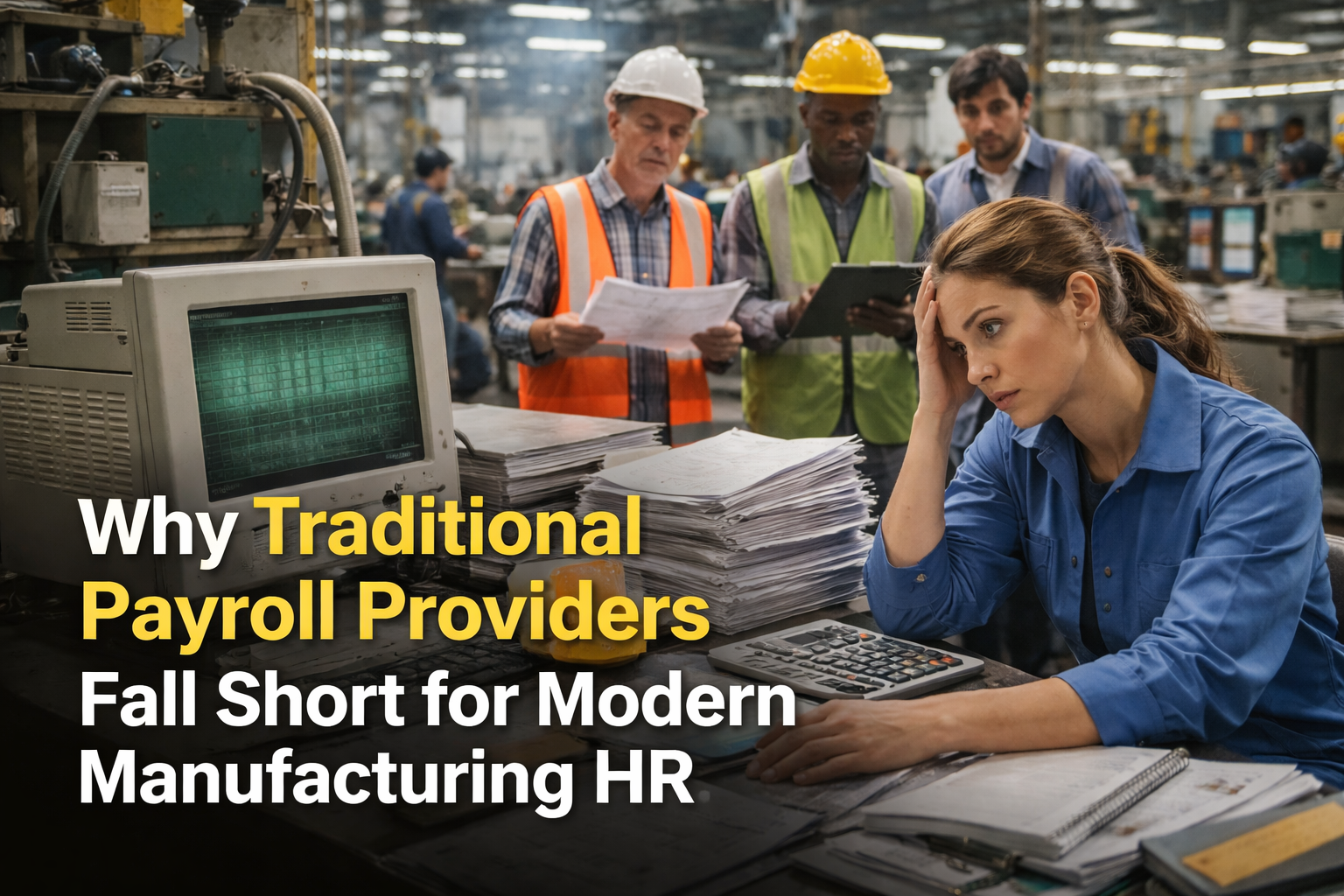
Let’s be blunt.
Manufacturing payroll is not office payroll with steel-toe boots.
Yet too many organizations with 100 to 1,000+ employees are still running their most complex workforce through systems designed for 9–5 desk jobs.
And HR is the one absorbing the impact.
In manufacturing, payroll isn’t just about cutting checks. It’s about navigating layered overtime rules, union contracts, shift premiums, seasonal surges, multi-state compliance, and time-clock integrations that can make or break accuracy. When payroll technology isn’t built for that reality, errors multiply fast, and they are expensive.
Manufacturing Payroll Is Structurally Different
Hourly workers.
Variable schedules.
Union-negotiated rules.
Overtime thresholds that differ by state.
Premium pay stacking.
Hazard pay.
Production bonuses.
Seasonal workforce spikes.
This is not a static workforce. It’s dynamic, operational, and highly regulated.
The U.S. Department of Labor continues to tighten scrutiny around overtime calculations and worker misclassification. SHRM reports that payroll and compliance errors remain one of the top legal exposure areas cited by senior HR leaders. In manufacturing, even minor inaccuracies in hours tracking can trigger cascading liability, unpaid overtime, wage claims, penalties, back pay, and reputational damage.
Generic payroll systems are not built to handle this complexity at scale.
Overtime, Premium Pay & Shift Differentials: Where Errors Multiply
Manufacturing HR teams deal with:
• Double-time rules
• Weekend premiums
• Third-shift differentials
• Collective bargaining agreement variations
• State-specific overtime thresholds
• Retroactive pay adjustments
Traditional payroll providers often rely on static rule configurations. But manufacturing requires dynamic rule engines that can stack and prioritize pay logic accurately across scenarios.
When systems can’t automate those rules correctly, HR teams resort to manual overrides.
Manual overrides create risk.
Risk creates audits.
Audits create penalties.
And suddenly, payroll isn’t administrative, it’s a compliance crisis.
The Integration Gap: Where Payroll Breaks the Shop Floor
Modern manufacturing runs on data:
Production systems.
Time clocks.
Shop-floor scheduling platforms.
HRIS platforms.
Benefits systems.
But when payroll sits in a silo, disconnected from real-time operational data, discrepancies happen.
Time clock rounding errors.
Supervisor edits without audit trails.
Delayed updates to employee classifications.
Multi-state tax misallocations.
HR tech reviews consistently show that integrated HCM systems outperform stand-alone payroll in both ROI and error reduction. Why? Because when time, labor, payroll, and compliance data live in one ecosystem, reconciliation disappears.
Best-of-breed payroll may look attractive on paper. But when it doesn’t integrate seamlessly with time and attendance, it creates more friction than flexibility.
And in manufacturing, friction costs money.
Misclassification: The Hidden Landmine
The DOL has increased enforcement around independent contractor classification and overtime eligibility. Manufacturing organizations that use seasonal workers, temporary labor, or specialized contractors face elevated exposure.
A payroll system that cannot clearly track classification status changes, or flag anomalies, becomes a liability multiplier.
HR leaders in manufacturing cannot afford reactive compliance. They need proactive visibility.
Why “Good Enough” Payroll Is No Longer Good Enough
Traditional payroll vendors focus on processing. Modern manufacturing HR needs intelligence.
Imagine payroll data that feeds directly into:
• Labor cost forecasting
• Production efficiency analytics
• Overtime trend analysis
• Workforce planning
• Union negotiation preparation
When payroll is unified within an HCM ecosystem, it becomes a strategic asset — not a back-office burden.
Instead of asking, “Did we pay people correctly?”
HR leaders should ask: “Why are overtime costs rising in Plant 3?”
“Which shifts are driving labor inefficiency?”
“Where are we exposed to compliance risk?”
That’s the shift.
What Manufacturing HR Leaders Should Demand
If you oversee 100–1,000+ employees in a manufacturing environment, payroll evaluation must go beyond:
Can it process pay? Does it issue direct deposits?
You need to ask:
• Does the rule engine support layered overtime logic?
• Can it integrate seamlessly with shop-floor systems?
• Does it automate compliance tracking across states?
• Are audit logs comprehensive and accessible?
• Does it unify payroll, time, and HR data?
Because in manufacturing, payroll errors aren’t minor inconveniences. They are operational disruptions. The future of manufacturing HR belongs to leaders who view payroll not as an expense center, but as a strategic control system.
This is the first in our manufacturing HR series, where we unpack the technology decisions that separate reactive HR teams from resilient, insight-driven leaders. If payroll complexity is rising in your organization, that’s not a problem. It’s a signal. And the right system turns that signal into strategy.
