
 5 min read
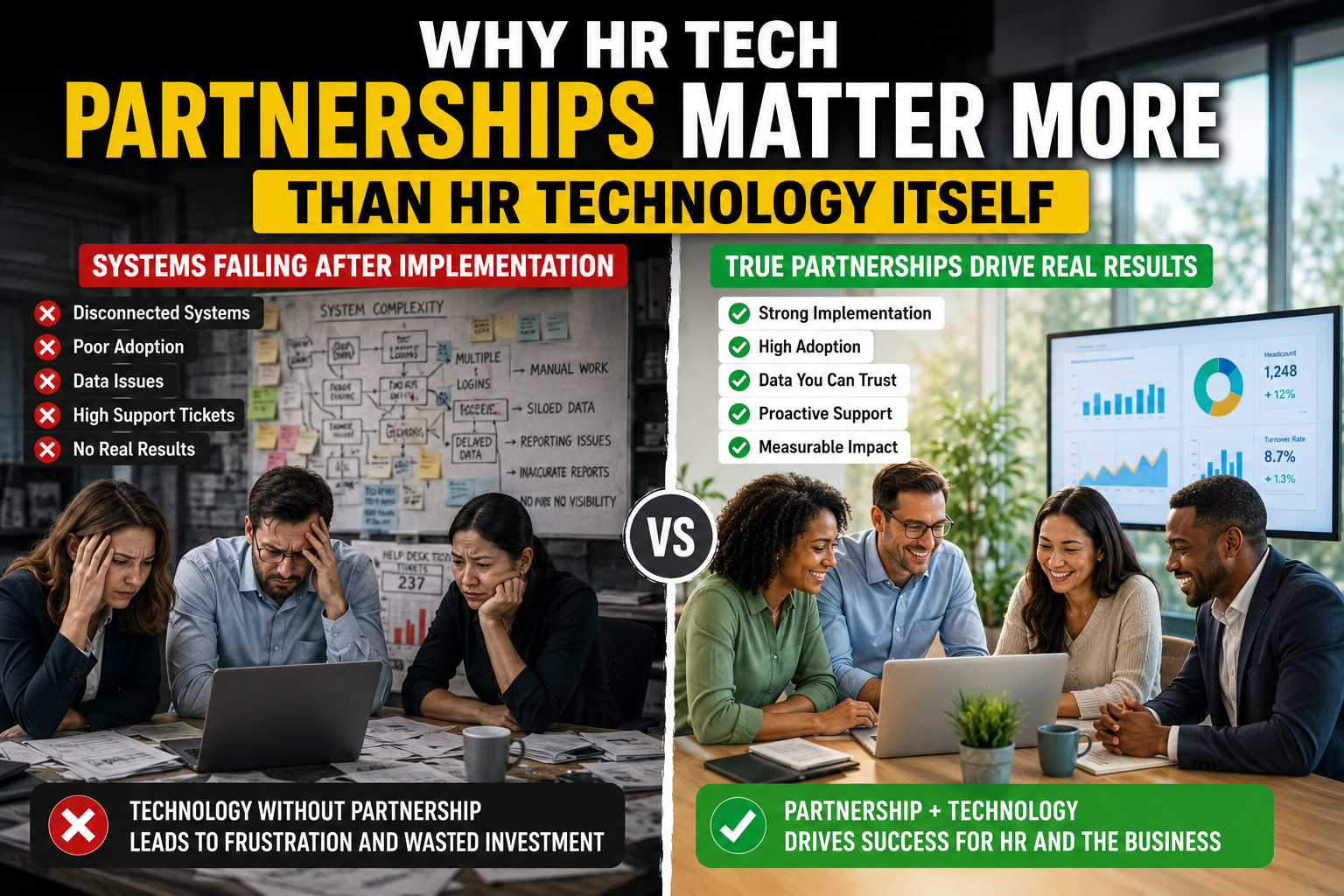
For years, the HR technology conversation has centered around features.
Who has the newest dashboard. Who has the most automation. Who has the longest feature checklist.
But many HR leaders eventually discover something uncomfortable: The software usually isn’t the real problem. The real problem is what happens after the contract is signed.
Because HR technology doesn’t operate in a vacuum. It lives inside fast-moving businesses where payroll deadlines don’t wait, compliance pressure is constant, hiring demands change overnight, and workforce complexity keeps growing.
And when those moments hit, features alone don’t help very much.
That’s where partnership becomes the difference between HR technology succeeding or quietly failing in the background while HR teams carry the burden.
Most HR Software Doesn’t Fail at Launch
This is one of the biggest misconceptions in the industry.
Most HR systems don’t fail because implementation completely collapses. In fact, many implementations technically “work.”
Employees get loaded. Payroll runs. Logins are created. The platform goes live.
From the outside, it looks successful.
But six months later, HR teams are still buried in manual processes. Reporting still takes hours. Managers avoid using the system. Compliance tracking lives in spreadsheets. Recruiting workflows are disconnected. Payroll teams build workarounds nobody planned for.
The software exists. Adoption doesn’t.
And over time, HR teams slowly adapt themselves to the limitations of the system instead of the system adapting to the business.
That’s not transformation. That’s survival.
HR Is No Longer Administrative Infrastructure
The role of HR has fundamentally changed.
Modern HR leaders are expected to influence retention, workforce planning, culture, operational efficiency, leadership development, and long-term business growth.
But many organizations still support HR with fragmented systems and transactional vendor relationships built for a completely different era.
The expectation is strategic leadership. The support model is still reactive support tickets.
That disconnect creates frustration across organizations.
HR leaders don’t need another vendor sending generic knowledge-base articles while critical workforce issues escalate internally. They need partners who understand the operational reality of the business itself.
Especially in industries like manufacturing, healthcare, logistics, and construction, workforce complexity isn’t theoretical. It’s operational pressure happening in real time.
The Hidden Cost of Weak HR Partnerships
Poor HR technology partnerships rarely fail loudly at first.
Instead, they create slow operational drag:
Manual duplicate work
Delayed reporting
Disconnected systems
Compliance exposure
Manager frustration
Payroll inefficiencies
Lack of visibility across the workforce
Burned-out HR teams
The danger is that many organizations normalize these problems. Teams begin accepting inefficiency as “just part of HR.”
It isn’t.
Most of these problems are solvable when HR technology is paired with the right strategic guidance and operational partnership.
Because the reality is simple:
A powerful system with a weak partnership usually underperforms. A strong partnership often unlocks far more value from the system than companies thought possible.
Partnership Changes the Entire Equation
A true HR technology partner does more than answer support tickets.
They challenge broken processes. They help architect scalable workflows. They identify operational risks before they become crises. They teach teams how to fully leverage the system. They adapt solutions as the business evolves.
Most importantly, they stay engaged long after implementation.
That matters because businesses change constantly.
Growth creates new complexity. New states create new compliance requirements. Acquisitions change workforce structures. Hiring surges pressure onboarding systems. Economic shifts impact workforce planning.
Static HR systems struggle in dynamic environments unless the partnership behind them evolves, too.
The Best HR Partnerships Build Internal Confidence
One of the strongest signs of a healthy HR technology partnership is this:
HR teams become more confident over time, not more dependent.
Weak vendors create reliance. Strong partners create capability.
The goal should never be to keep organizations dependent on external support forever. The goal is to help internal teams understand their systems deeply enough to lead with confidence.
When that happens, HR shifts from reactive administration to strategic influence.
Reporting becomes faster.
Decision-making improves.
Workflows scale more effectively.
Managers become more self-sufficient.
Employees get a better experience.
And HR finally gets space to focus on the work that actually moves the business forward.
The Future of HR Technology Isn’t More Features
The future of HR technology is alignment.
Alignment between systems and operations.Between workforce strategy and business goals. Between technology providers and HR leaders.
Organizations are no longer looking for software alone. They are looking for guidance, adaptability, expertise, and long-term partnership.
Because technology can automate processes.
But partnership builds confidence.
And in today’s workforce environment, confidence might be the most valuable thing an HR leader can have.
