
 4 min read
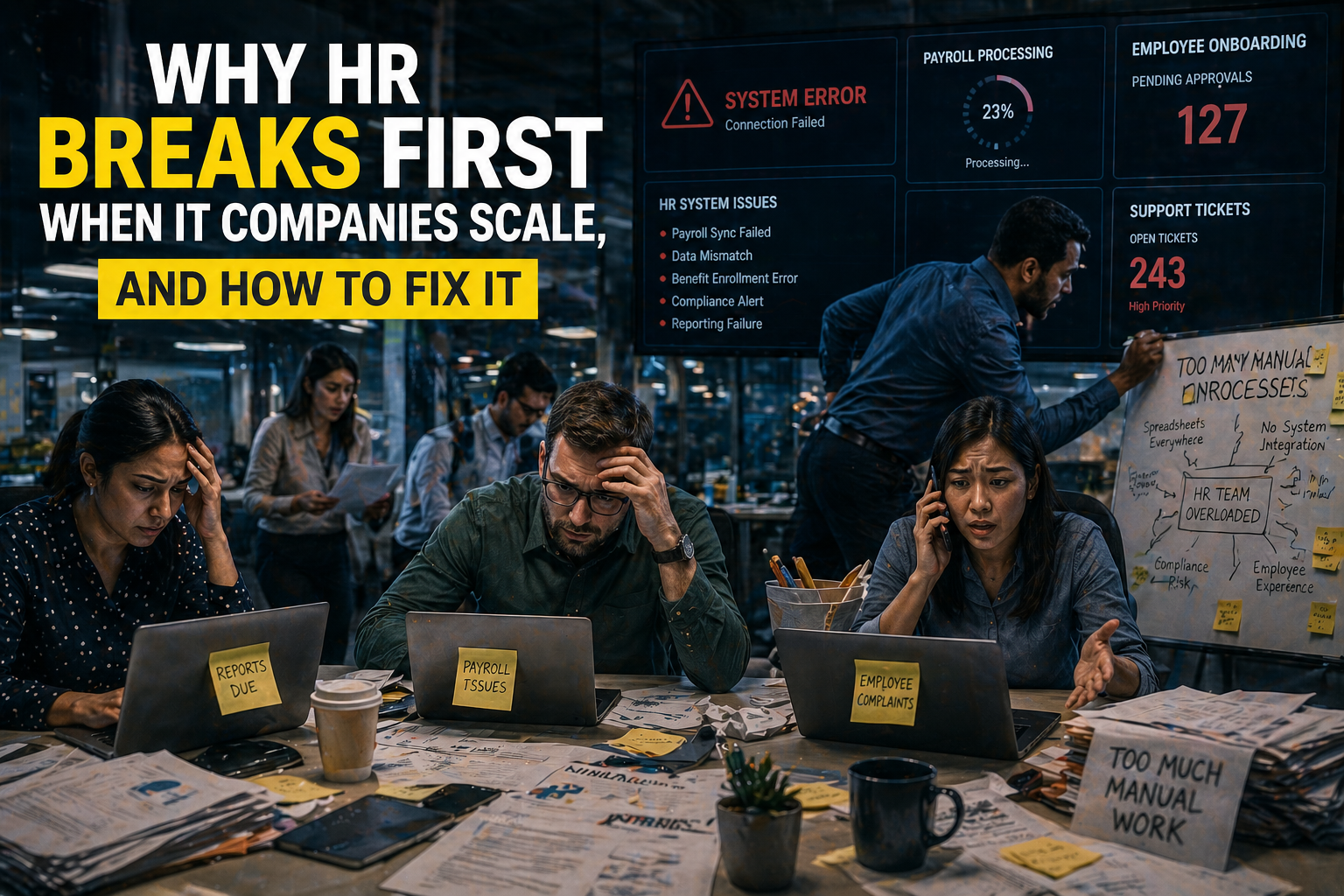
Scaling an IT business sounds like a success story, until HR starts falling apart behind the scenes. At 200 employees, your systems still hold. At 500, cracks appear. By 1,000+, HR and payroll complexity doesn’t just increase, it compounds. Suddenly, what once worked becomes a daily operational risk.
The reality? Most IT companies don’t outgrow their talent strategy. They outgrow their infrastructure.
The Hidden Complexity of IT Workforce Management
IT organizations operate in a uniquely complex environment:
- Distributed and remote teams across regions or countries
- Multiple employment types (full-time, contractors, project-based)
- Fast hiring cycles driven by client demand
- Constant role changes, promotions, and skill shifts
On paper, it looks manageable. In practice, it’s chaos without the right systems.
HR teams are left stitching together disconnected tools—payroll in one place, time tracking in another, onboarding somewhere else entirely. Every manual workaround introduces risk:
- Payroll errors that damage trust
- Delayed onboarding that slows productivity
- Reporting gaps that leave leadership blind
And when something breaks? HR becomes reactive instead of strategic.
Where Most IT Companies Get It Wrong
The biggest mistake isn’t choosing the wrong software; it’s choosing software that can’t scale with complexity.
Many platforms are designed for static organizations. IT companies are anything but static.
What happens next is predictable:
- HR teams build manual processes to compensate
- Support tickets pile up with slow response times
- Internal knowledge becomes siloed and fragile
Sound familiar? That’s not a people problem. That’s a system failure.
The Breaking Point: Growth Without Control
As IT companies scale, three pressure points emerge:
1. Payroll Complexity Explodes
Multiple pay structures, bonuses, and contractor payments create layers of risk. Manual calculations are no longer sustainable.
2. Onboarding Becomes a Bottleneck
Hiring fast is meaningless if onboarding is slow, inconsistent, or error-prone.
3. Visibility Disappears
Leadership can’t make informed decisions without accurate, real-time data—and most systems don’t deliver it.
At this stage, HR isn’t just under pressure; it’s overwhelmed.
What Great HR Looks Like in IT at Scale
High-performing IT companies don’t just “manage” HR. They engineer it.
Here’s what that looks like:
1. One System, Not Five
Everything, HR, payroll, time tracking, and onboarding, lives in a single, unified platform. No duplication. No gaps. No guesswork.
2. Automation Over Manual Work
Payroll calculations, compliance rules, and workflows are automated. HR teams stop chasing tasks and start driving outcomes.
3. Real-Time Support, Not Ticket Queues
When issues arise, they’re resolved immediately, not days or weeks later. Because payroll can’t wait.
4. Customization That Matches Reality
IT companies aren’t cookie-cutter. Your HR system shouldn’t be either. Role-based access, tailored workflows, and flexible reporting are non-negotiable.
5. Visibility at Every Level
From executives to managers, everyone has access to the data they need—without compromising security.
The Shift from Reactive to Strategic HR
The difference between struggling HR teams and high-performing ones isn’t effort—it’s enablement.
When systems are built to handle complexity:
- HR teams reclaim hours every week
- Managers engage more actively with workforce data
- Employees experience smoother onboarding and payroll accuracy
Most importantly, HR shifts from firefighting to forward planning.
The Bottom Line
Scaling an IT company without scaling HR infrastructure is a risk most businesses don’t realize they’re taking, until it’s too late.
The companies that win aren’t the ones with the most features.
They’re the ones with systems, and partners, that can handle real-world complexity.
Because in IT, growth isn’t the challenge. Controlling it is.
