
 8 min read
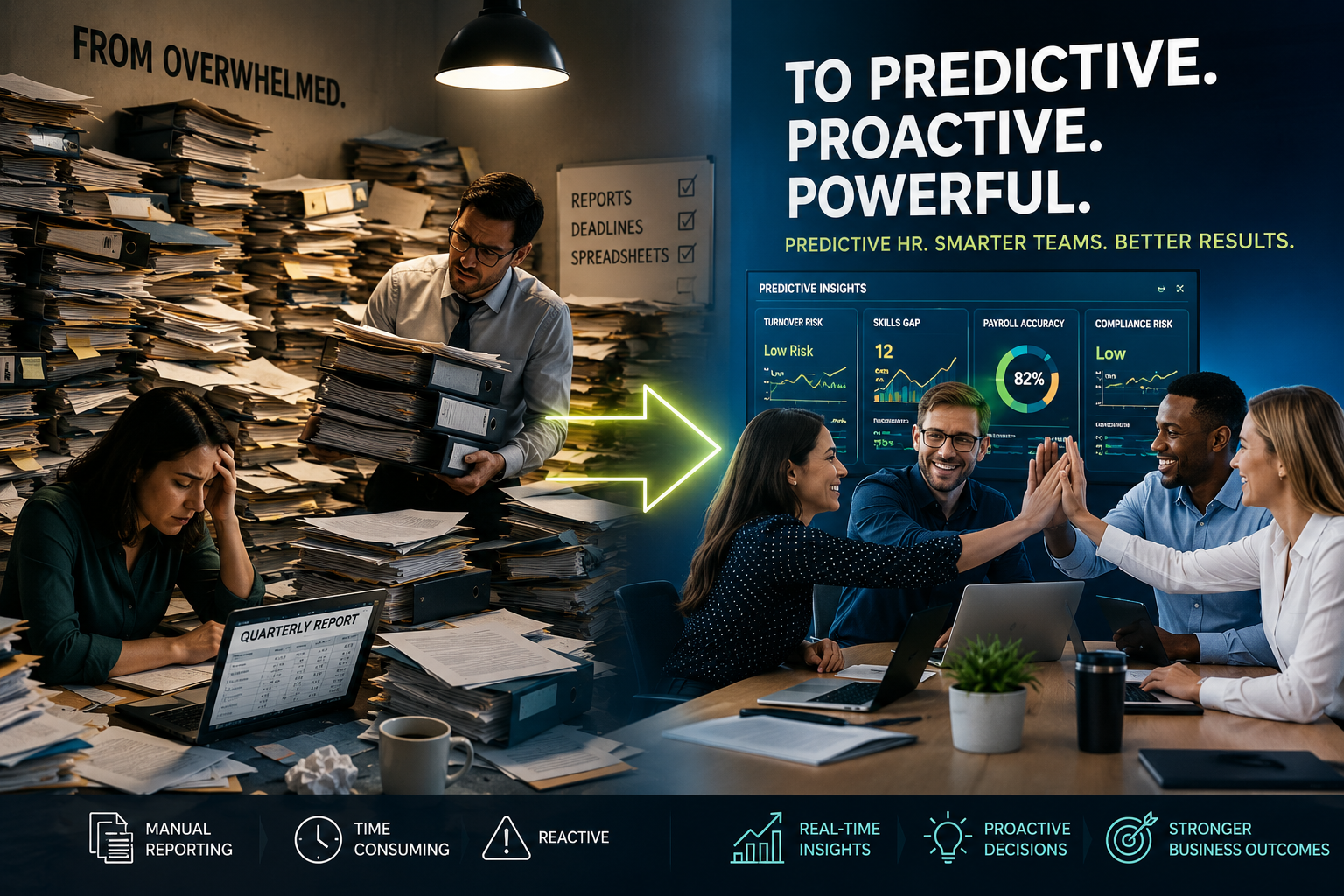
For decades, HR has operated in the rearview mirror.
Monthly reports. Quarterly reviews. Annual workforce analyses.
The process has become so embedded in organizations that many leaders rarely question it. HR collects data, builds reports, analyzes trends, and presents findings to leadership.
The problem?
By the time the report reaches the boardroom, the damage may already be done.
The resignation already happened. The compliance risk already exists. The burnout is already spreading.
The payroll error has already impacted employee trust.
For years, reporting has been the backbone of HR decision-making. But in today's business environment, reporting alone is no longer enough.
The organizations pulling ahead are making a fundamental shift—from reporting on the past to predicting the future.
Welcome to the era of Predictive HR.
The Problem With Traditional HR Reporting
Traditional reporting answers one question exceptionally well: "What happened?"
That's useful.
But it's increasingly insufficient.
Modern organizations operate in environments that move faster than ever before. Labor markets shift overnight. Employee expectations evolve constantly. Regulatory requirements become more complex. Workforce needs change faster than annual planning cycles can accommodate.
In this environment, hindsight is expensive.
A report showing turnover increased by 15% last quarter doesn't solve the problem.
A report identifying burnout after employees have already resigned doesn't help retain them.
A report highlighting compliance issues after an audit begins doesn't reduce risk.
The challenge isn't the quality of reporting.
The challenge is timing.
Organizations need visibility before problems become outcomes.
Why Predictive HR Is Becoming a Business Imperative
Predictive HR changes the conversation entirely.
Instead of asking: "What went wrong?"
Organizations can ask: "What is likely to happen next?"
And more importantly: "What should we do about it?"
This shift moves HR from an administrative function to a strategic business driver.
It transforms workforce data from historical records into actionable intelligence.
Leading organizations are already using predictive workforce models to identify:
- Turnover risk before employees resign
- Skill shortages before projects are impacted
- Payroll anomalies before errors reach employees
- Compliance gaps before audits occur
- Staffing shortages before production suffers
- Burnout indicators before performance declines
- Absenteeism trends before operational disruptions emerge
The goal is simple: Prevent problems instead of reacting to them.
The Rise of Workforce Intelligence
The next generation of HR isn't built around reports.
It's built around intelligence.
Think about every major business function.
Finance uses forecasting. Supply chain uses demand planning. Sales uses pipeline predictions. Marketing uses attribution models and predictive analytics.
Yet many HR departments still operate primarily through historical reporting.
That gap is closing rapidly.
Workforce intelligence is becoming one of the most important competitive advantages organizations can develop.
Because people-related decisions impact every aspect of business performance.
Revenue.
Productivity.
Customer satisfaction.
Operational efficiency.
Innovation.
Growth.
The organizations that understand workforce trends before competitors do gain an enormous strategic advantage.
Payroll: Where Prediction Matters Most
Perhaps nowhere is predictive HR more valuable than payroll.
Payroll is often viewed as a back-office process.
In reality, it is one of the most visible expressions of organizational trust.
Employees can tolerate many workplace frustrations.
They rarely tolerate payroll mistakes.
One missed paycheck. One compliance error. One inaccurate deduction.
Trust disappears quickly.
Predictive payroll technologies are helping organizations identify irregularities before payroll is finalized.
Instead of finding errors after employees are paid, organizations can identify anomalies in real time and resolve them proactively.
The result?
Greater accuracy. Reduced compliance exposure. Improved employee trust.
Workforce Planning Is Becoming Predictive
One of the biggest challenges facing HR leaders today is uncertainty.
Organizations struggle to answer critical questions:
Do we have enough people? Do we have the right skills?
What positions will become critical next year? Where are our workforce vulnerabilities?
Historically, workforce planning relied heavily on assumptions.
Today, workforce intelligence allows organizations to make planning decisions based on emerging patterns instead of guesswork.
The result is more strategic hiring, stronger retention planning, and improved organizational agility.
Organizations stop chasing workforce problems.
They start anticipating them.
Why Many HR Systems Are Falling Behind
The reality is that many HR platforms were designed for record-keeping.
Not intelligence.
Their primary purpose was storing employee data, managing transactions, and generating reports.
That worked for years.
But the expectations placed on HR have changed dramatically.
Today's leaders expect HR to contribute directly to business outcomes.
That requires systems capable of:
- Continuous data processing
- Real-time analytics
- Automated insights
- Trend identification
- Predictive modeling
- Proactive alerts
The future belongs to organizations that can move from collecting data to activating it.
The Future of HR Is Proactive
The most successful HR leaders in the next decade won't be the ones producing the most reports.
They'll be the ones generating the best insights. Because reporting tells you where you've been.
Prediction tells you where you're going.
And in a business environment defined by rapid change, uncertainty, and workforce complexity, knowing what's coming next is becoming one of the most valuable capabilities an organization can possess.
The future of HR isn't reporting. The future of HR is foresight.
And for organizations still relying solely on yesterday's data to make tomorrow's decisions, the future may arrive sooner than they think.
