
 4 min read
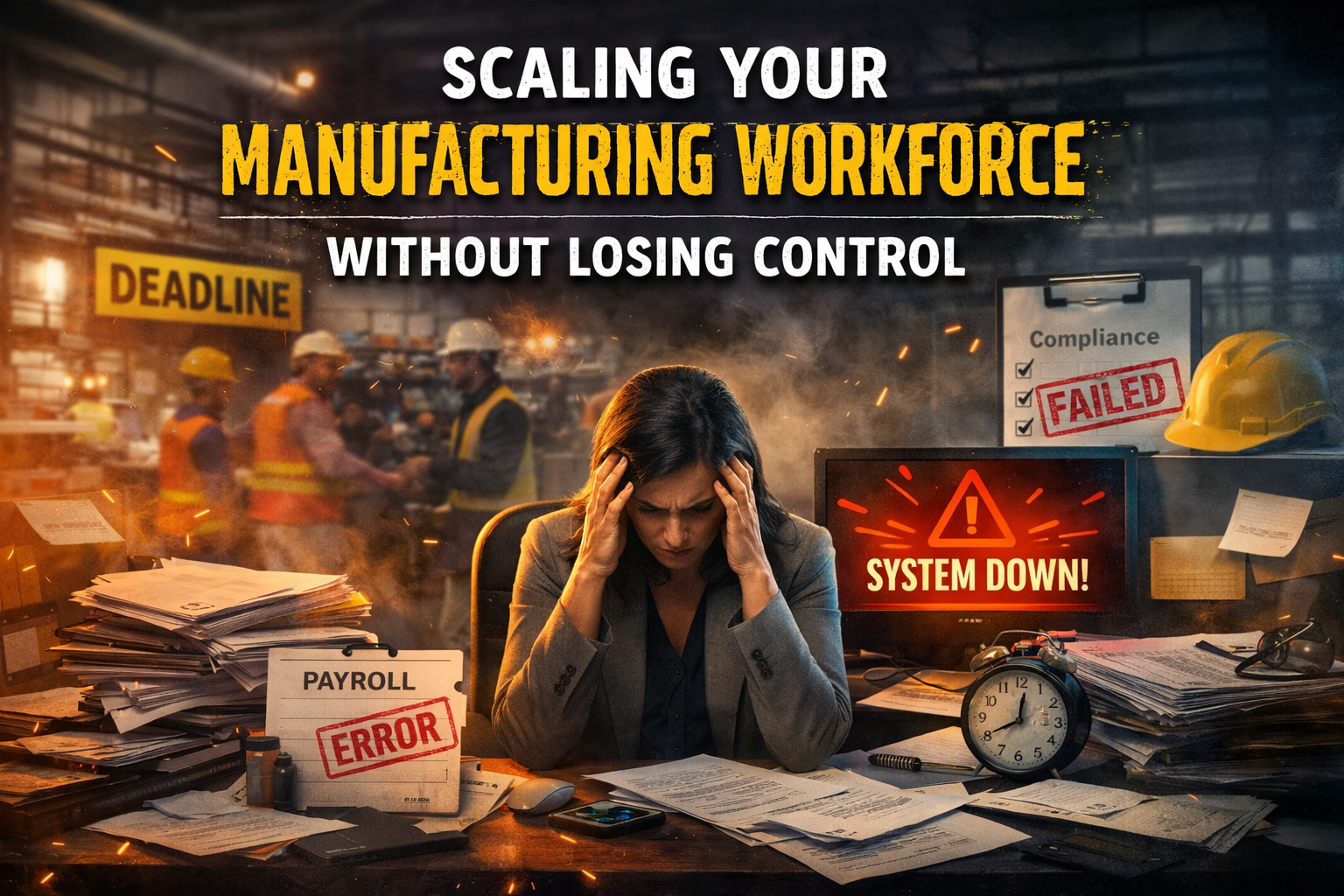
HR Lessons from Rapid Growth
For many manufacturing companies in the U.S., growth is back, and it’s happening fast.
New contracts. Expanded production lines. Increased demand driven by reshoring, infrastructure investment, and supply chain realignment. On paper, it’s exactly what manufacturers have been hoping for.
But behind the scenes, many HR teams are facing a different reality.
Hiring surges, complex onboarding, compliance pressure, and operational chaos are becoming the unintended side effects of growth. For organizations with 100–1000+ employees, scaling a workforce without scaling the systems and processes that support it can quickly overwhelm HR teams.
The result? HR moves from strategic partner to operational firefighter.
And that’s where the real risk begins.
The Manufacturing Hiring Surge Is Real
Research from Deloitte and McKinsey shows that the manufacturing sector will need millions of new workers over the next decade to meet demand and replace retiring talent.
But here’s the challenge: the labor pool isn’t growing at the same pace.
Manufacturers are competing aggressively for technicians, operators, engineers, and skilled production workers. SHRM reports that talent scarcity remains one of the top operational risks for industrial organizations heading into 2026.
When hiring ramps up quickly, HR departments often face pressure to move faster than their processes can handle.
Suddenly, job postings multiply. Interview pipelines expand. Hiring managers demand faster turnaround times.
If HR doesn’t have scalable recruiting systems and workflows in place, growth quickly turns into chaos.
Manufacturing Onboarding Is More Complex Than Most Industries
Hiring someone is only the first step.
Manufacturing onboarding involves far more than paperwork and introductions. It includes:
Safety training
Equipment certifications
Compliance documentation
Job-level and shift-specific training
Union or labor regulations in some environments
Plant-specific procedures
Now imagine onboarding dozens, sometimes hundreds, of employees within a short period.
Without structured systems, HR teams end up managing onboarding through spreadsheets, manual checklists, and endless email chains. Information gets lost. Certifications fall through the cracks. Safety training becomes inconsistent.
In an industry where safety and compliance are non-negotiable, that’s a serious risk.
Growth Can Break Culture
Manufacturing organizations often take pride in strong plant cultures, built on teamwork, safety, reliability, and accountability.
But rapid growth can fracture that culture if HR doesn’t scale communication and leadership development alongside hiring.
When new employees enter the organization faster than culture can be reinforced, several issues emerge:
Inconsistent training
Different practices across plants
Confusion around expectations
Disconnected teams
Employees begin to feel like they’re working for different companies depending on the location or shift.
Maintaining consistency across distributed plants requires structured onboarding, standardized communication, and leadership alignment.
That doesn’t happen by accident.
The Hidden Problem: HR Teams Get Buried
One of the most overlooked consequences of workforce expansion is the strain it places on HR teams.
Administrative workload explodes:
More candidate communication
More onboarding coordination
More documentation tracking
More compliance oversight
More employee questions
Instead of focusing on workforce planning, retention strategies, and leadership development, HR teams spend their time chasing paperwork and fixing operational bottlenecks.
Gartner research consistently shows that administrative overload prevents HR departments from delivering the strategic value organizations actually need.
In manufacturing environments, that gap becomes especially costly.
Technology Is No Longer Optional for Scaling HR
Manufacturing leaders understand the importance of operational efficiency on the production floor.
But many organizations still rely on fragmented systems to manage their workforce.
Applicant tracking lives in one system.
Onboarding happens in another.
Training records are stored somewhere else.
Compliance tracking sits in spreadsheets.
The result is disconnected data, duplicated work, and unnecessary risk.
Forward-thinking manufacturers are solving this by unifying workforce systems into integrated platforms that connect:
Recruiting
Onboarding
Training
Compliance tracking
Employee records
When HR teams have real-time visibility into the workforce, they can scale hiring while maintaining control over safety, documentation, and employee experience.
