
 5 min read
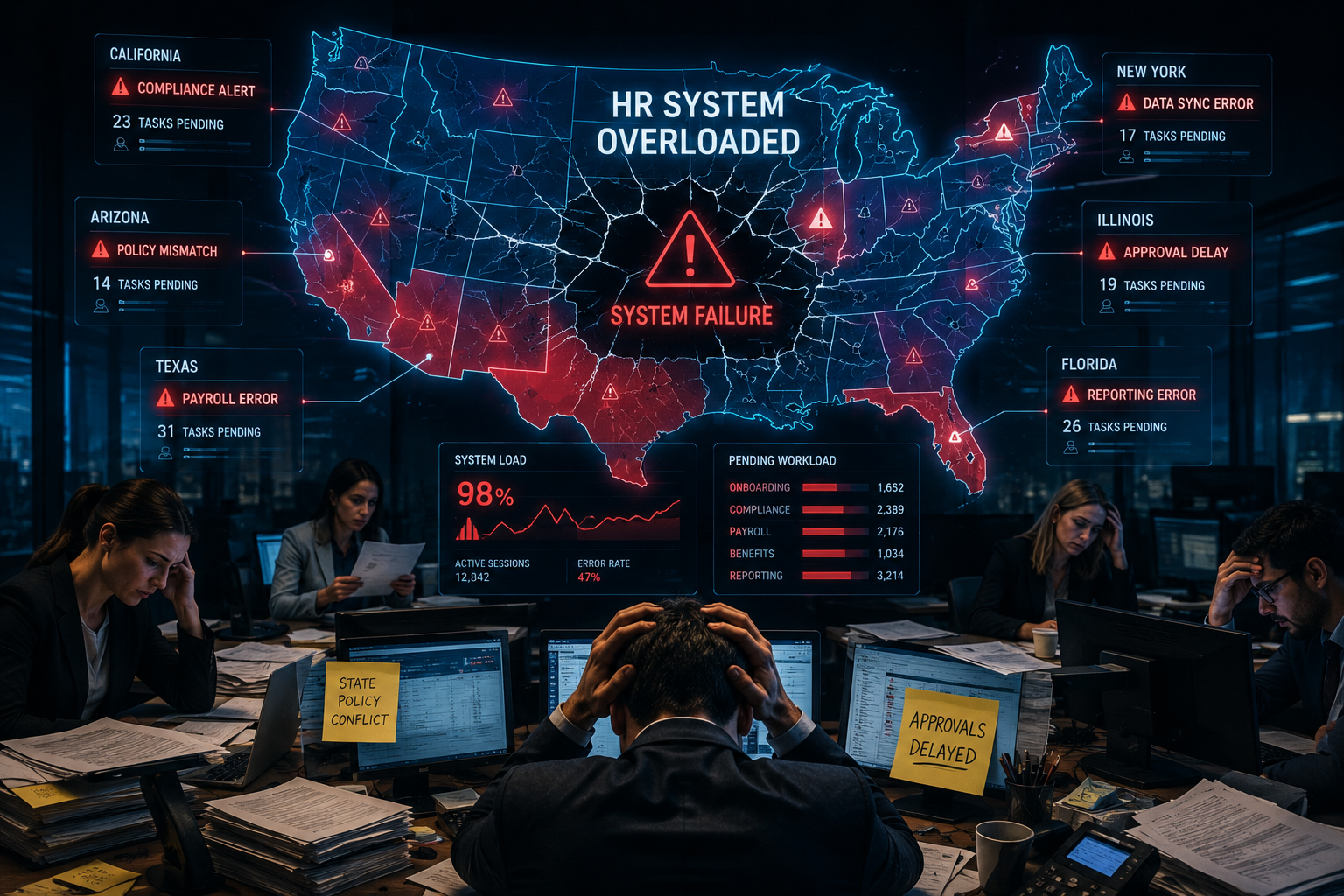
For growing organizations, expansion sounds exciting on paper.
A new state. A new facility. A larger workforce. More opportunities. But for HR and payroll teams, multi-state growth often introduces something far less exciting: operational risk at scale.
What starts as “just adding another location” quickly becomes a maze of tax rules, wage laws, labor regulations, leave requirements, reporting obligations, and compliance deadlines that vary dramatically from state to state.
And here’s the uncomfortable reality many organizations eventually face:
Most HR systems, and most HR processes, weren’t built for this level of complexity.
That’s where cracks begin to form.
Compliance Isn’t Static Anymore
One of the biggest misconceptions in HR is the belief that compliance is a one-time setup.
It isn’t.
Multi-state compliance is a moving target. Laws shift constantly. Wage thresholds change. Paid leave requirements evolve. Tax jurisdictions update. Overtime rules differ. Local municipalities introduce additional regulations layered on top of state requirements.
For HR teams managing employees across multiple states, the challenge isn’t simply understanding the rules.
It’s maintaining consistency while those rules continue changing underneath you.
And when organizations grow quickly, compliance gaps don’t scale linearly—they multiply.
A small process issue affecting 50 employees can become a major operational problem affecting 5,000.
The Hidden Cost of Manual Processes
Many organizations don’t realize how fragile their compliance operations are because manual work has quietly become normalized.
Spreadsheets. Email approvals. Separate systems. Offline tracking. Human memory.
At a smaller scale, these workarounds feel manageable. At multi-state scale, they become dangerous.
HR teams often end up manually tracking:
- State-specific leave laws
- Wage notices
- Certification expirations
- Payroll exceptions
- Shift differentials
- Local tax requirements
- Overtime calculations
- Prevailing wage requirements
The issue isn’t that HR professionals lack expertise. In fact, many teams are performing extraordinary work under difficult conditions.
The issue is that humans cannot sustainably manage enterprise-level complexity through fragmented systems forever.
Eventually, something gets missed.
And in compliance, small misses become expensive very quickly.
Payroll Is Often the First Place Problems Surface
In manufacturing, healthcare, logistics, construction, and distributed workforce environments, payroll becomes one of the biggest pressure points in multi-state operations.
Different pay rules across locations. Different overtime structures. Different union requirements. Different tax obligations.
One organization may have employees working across multiple states within the same pay period. Another may manage dozens of local tax jurisdictions simultaneously.
What appears simple from the outside becomes operationally intense behind the scenes.
This is why payroll errors tend to become an early warning sign of larger system problems.
When HR teams rely on disconnected systems and manual intervention to “make things work,” payroll processing becomes reactive instead of controlled.
That creates stress internally, and damages trust externally.
Because employees may tolerate many things. But they rarely tolerate payroll mistakes.
Growth Exposes Weak Infrastructure
One of the most important lessons growing organizations eventually learn is this:
Growth doesn’t create operational weaknesses. It exposes them.
A process that works for one location may collapse under five.
A reporting structure that functions with 200 employees may become unmanageable at 2,000.
A fragmented HR environment may survive during stable periods but break under hiring surges, acquisitions, seasonal staffing fluctuations, or geographic expansion.
This is why scalable infrastructure matters so much. Not because HR teams want “better software.”
Because organizations need operational visibility and consistency across increasingly complex environments.
HR Is No Longer Administrative
The role of HR has fundamentally changed.
Today’s HR leaders are expected to support workforce planning, operational efficiency, retention strategy, compliance management, employee experience, and business growth simultaneously.
That’s difficult to achieve when teams are buried under administrative overload.
The organizations navigating multi-state complexity most effectively are not necessarily the ones with the biggest HR departments.
They’re the ones that have created systems, workflows, and operational structures that reduce friction instead of adding to it.
They’ve moved away from fragmented processes and toward integrated workforce management.
Not because it’s trendy. Because it’s necessary.
The Future of Compliance Is Visibility
The companies winning in multi-state environments are focusing on one critical capability: visibility.
Visibility into:
- Workforce data
- Compliance status
- Payroll accuracy
- Training completion
- Labor allocation
- Documentation tracking
- Real-time reporting
When HR leaders can see the workforce clearly, they can make faster, more confident decisions.
Without visibility, organizations operate reactively.
And reactive HR is expensive HR.
The bottom line is:
Multi-state compliance isn’t becoming simpler.
It’s becoming more dynamic, more distributed, and more operationally connected to business performance itself.
The challenge for HR leaders moving forward isn’t simply keeping up with regulations.
It’s building an infrastructure capable of adapting as complexity grows.
Because in modern workforce management, compliance is no longer just a legal issue.
It’s an operational strategy.
