
 6 min read
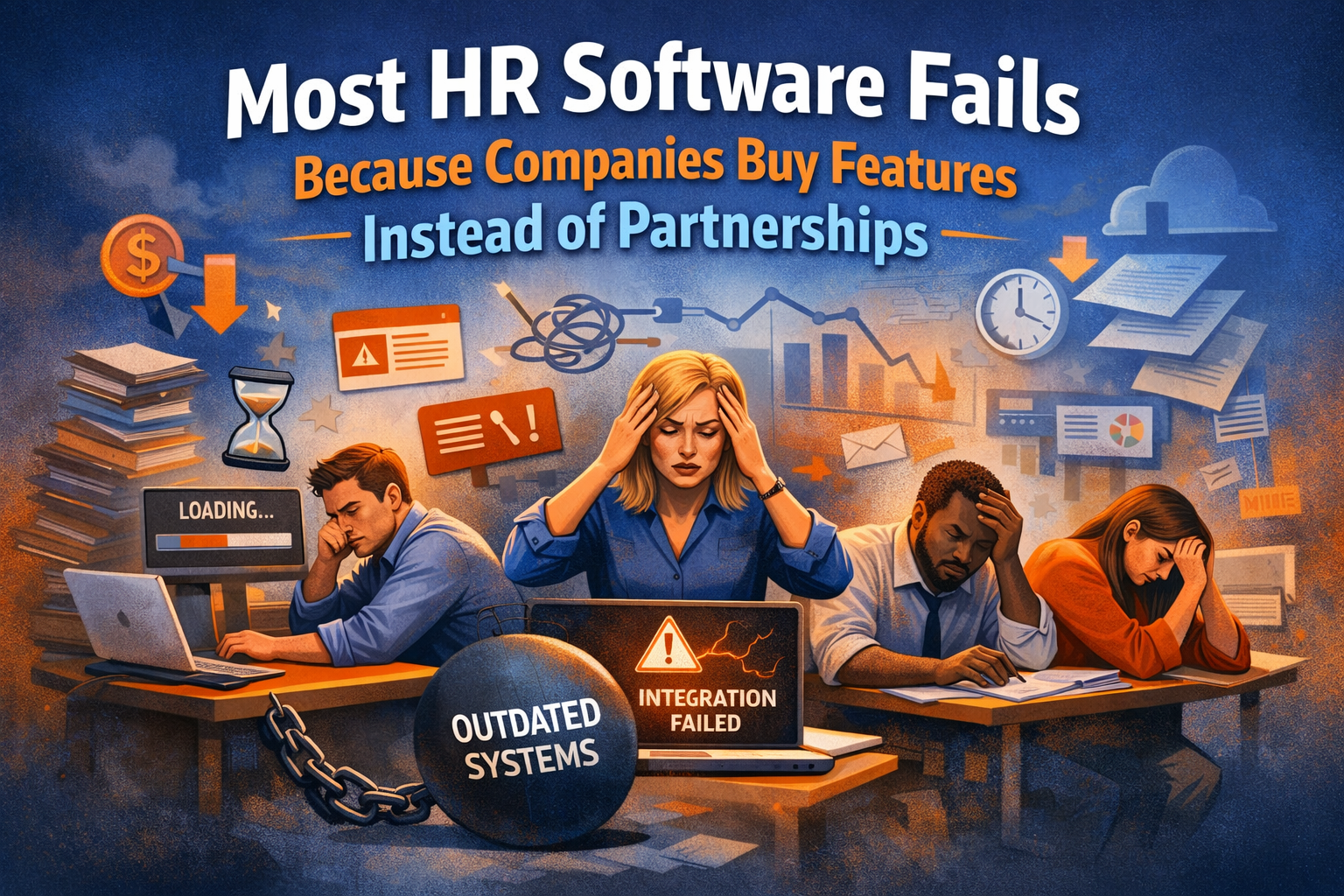
In today’s rapidly evolving HR landscape, organizations are leaning more and more on technology to modernize how they attract, manage, and retain talent. But for many mid-to-large companies (think 500–1,000 employees), HR tech isn’t delivering the impact they expected. Why? Because they invested in features, not partnerships, and that mistake comes at a cost.
Why So Many HR Software Projects Go Off the Rails
Regret Is Real, and ExpensiveAccording to Capterra’s 2025 Tech Trends Survey, 62% of companies that later regretted their HR software purchase described the financial impact as “significant or monumental.”
What’s driving that regret? Often, it's because buyers focused almost exclusively on the vendor’s sales pitch, neglecting third-party analysis, peer feedback, or a holistic view of their future needs.
Worse still, 64% of those regretful buyers said they were the sole decision-maker in the process, meaning key stakeholders, like IT, finance, and end users, were left out.
That kind of narrow decision-making can backfire: underestimated costs for implementation, data migration, customization, training, and ongoing support can all blow out the true cost of ownership.
The Human Factor Gets Underestimated
Technology is powerful, but its full potential only comes to life when people actually use it. According to SHRM, the biggest failure point isn’t technical; it’s human behavior.
Without formal training, dedicated change management, or tailored adoption strategies, many HR teams assume their users will “just figure it out.” But that often isn’t what happens.
The result? Low usage, poor ROI, and frustration. When implementation teams don’t build in time for communication, coaching, and digital “nudges,” adoption stalls fast.
Misaligned Goals: Features Over Business Value
Many software buyers make the mistake of buying what looks good on paper instead of what actually addresses business pain points.
According to experts, projects often fail because they lack a clear strategic alignment between the HR tech solution and the company’s broader objectives.
Without that alignment, you end up with “feature creep”, a shiny system full of bells and whistles, but no real way to drive value.
Change Management & Governance Are Afterthoughts
Implementing HR software is not just a tech project; it’s an organizational transformation. Yet, many companies undervalue the non-technical stuff: stakeholder buy-in, governance, and a robust change management plan.
When communication is weak, employees don’t understand “what’s in it for me,” and they default to old habits. Even worse, when post-go-live support is limited, adoption drops off, and the system becomes an expensive, underused relic.
Modern HR tech doesn’t live in a vacuum — it has to connect to existing systems. But legacy infrastructure, siloed data, and complex integrations often derail projects.
If your software can't talk to payroll, performance management, or benefits systems, you risk fragmentation, user frustration, and duplicated work. Without a trusted partner working alongside you, rather than just selling you a license, integration and data migration become bigger hurdles than expected.
Partnerships Over Features: A Better Approach for HR Teams
So, what should HR leaders at mid-to-large companies do differently? Here are some guiding principles for building a sustainable, future-ready HR tech ecosystem:
- Define Strategic Objectives, Not Just Feature Wish Lists
Begin with business goals: What business problems are you trying to solve? Lower turnover? Better engagement? Faster hiring? Focus on value first, features second. - Form a Cross-Functional Selection Team
Involve HR, IT, Finance, and real users early. Diverse perspectives will help you evaluate long-term impact, not just short-term functionality. - Vet Vendors as Partners
Beyond a product demo, evaluate a vendor’s commitment to your success. Ask about: - Their implementation and change management methodology
- Ongoing training & support
- Roadmap alignment with your goals
- Customer success stories with organizations similar to yours
- Invest in Change Management & Training
Plan for more than “go live.” Build in communication and training before, during, and after launch. Leverage digital nudges, champions in each department, and continuous feedback loops - Ensure Strong Data & Integration Planning
Identify legacy systems up-front, understand data flows, and work closely with your IT partner (or your vendor as a partner) to ensure seamless integration. - Measure ROI and Adapt
Track usage, adoption, and business metrics. Don’t treat implementation as a one-time project; treat it as a journey. Set milestones, measure impact, and course-correct as needed.
Why HR Teams Are the “Stability Anchors” of Their Organizations
In mid- to large-sized companies, HR isn’t just a back-office function; it’s a strategic anchor. When HR technology is done well, it supports:
- Scalable growth: As organizations scale, HR tools must adapt- and that requires more than plug-and-play features.
- Employee experience: You need systems that employees will actually use, not just admire.
- Strategic agility: With the right partner, HR teams can iterate, innovate, and evolve tech in line with business priorities.
- Risk mitigation: HR handles sensitive data, compliance, and talent risk. A trusted partner helps safeguard these areas and ensures your software scales securely.
When organizations buy HR software based on checklists or shiny features, they often overlook the human and partnership elements that make or break long-term success. The result? Massive regret, wasted budgets, and fragmented adoption.
But by shifting the mindset from “What features can you give me?” to “How can we grow together?” HR leaders can build truly strategic, long-lasting tech ecosystems, ones that align with business goals, support their people, and withstand the test of change.
If you’re evaluating HR technology, don’t skip the step of vetting not just the product, but the vendor as a partner. That’s where sustainable value lies.
