
 5 min read
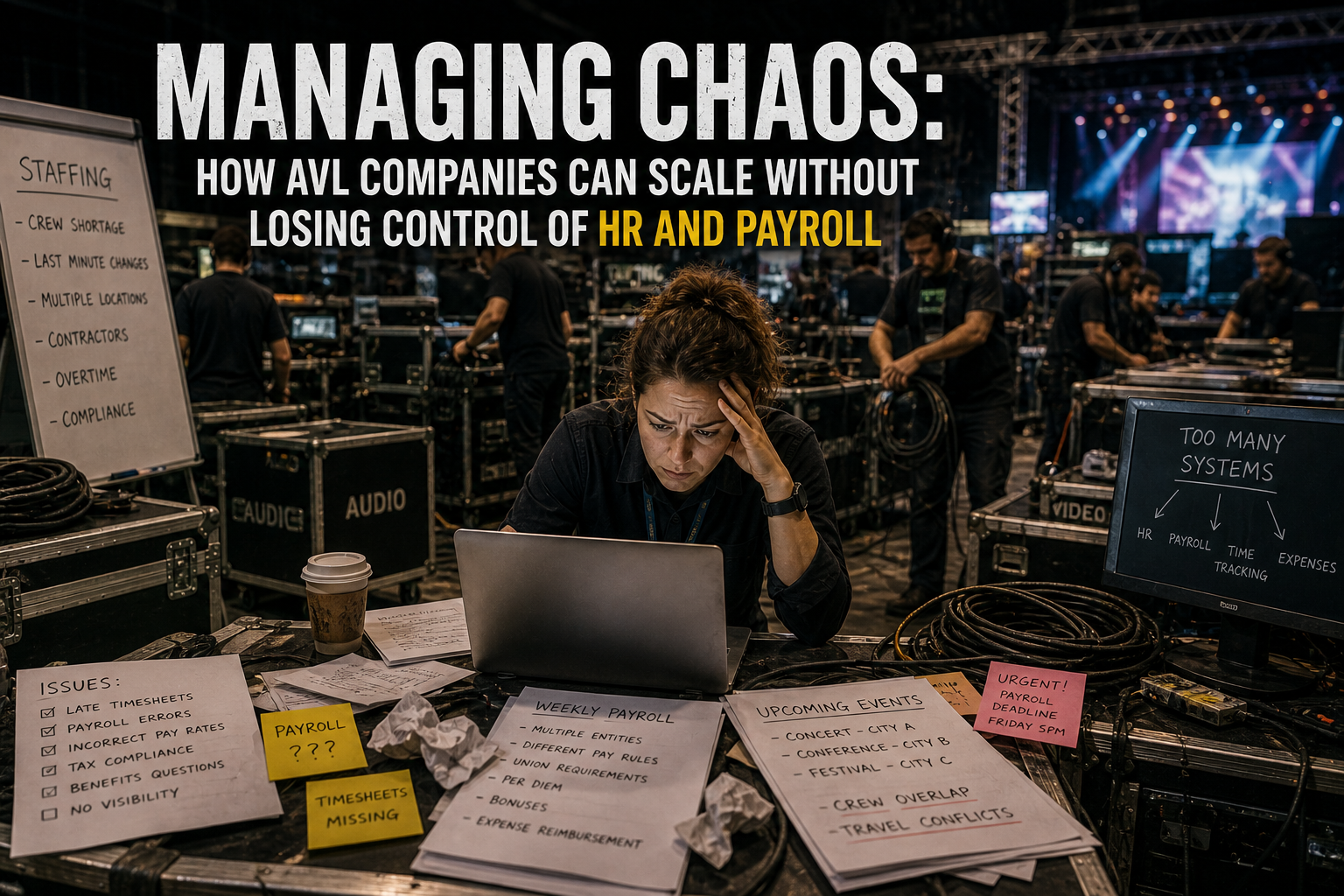
The AVL industry doesn’t operate in a controlled environment, and neither does its workforce.
From stadium installations to live events, university projects to municipal contracts, AVL companies juggle:
- Project-based work across multiple locations
- Complex pay rules and compliance requirements
- Rapidly shifting teams and schedules
At 200 employees, it’s manageable. At 1,000+, it becomes operational chaos, unless HR evolves.
The Reality of HR in AVL
Unlike traditional industries, AVL businesses deal with layers of complexity that most systems aren’t designed to handle:
- Prevailing wage requirements across states or regions
- Different pay rates based on roles, shifts, and job sites
- Daily and weekly overtime rules that vary by project
- Mobile workforces with constantly changing schedules
Without the right infrastructure, HR teams are forced into manual workarounds just to keep up.
And that’s where things start to break.
When Systems Can’t Keep Up
Many AVL companies rely on outdated or rigid systems that weren’t built for dynamic workforces.
The result?
- Payroll becomes a manual, error-prone process
- HR teams spend hours calculating compliance rules
- Onboarding is inconsistent and disconnected
- Support from vendors is slow, or nonexistent
Instead of enabling growth, technology becomes the bottleneck.
The Cost of “Figuring It Out”
When HR teams are left to build processes on their own:
- Errors increase
- Time is wasted
- Confidence drops
In industries like AVL, where margins are tight and timelines are critical, these inefficiencies don’t just slow you down; they cost you money.
And when support teams respond with “that’s not something we do”? You’re not dealing with a partner. You’re on your own.
Where Scaling Gets Risky
As AVL companies grow, three critical areas become pressure points:
1. Compliance Becomes Unmanageable
Prevailing wage rules, overtime variations, and multi-location requirements are too complex for manual handling.
2. Workforce Tracking Breaks Down
Tracking hours across job sites, teams, and roles becomes inconsistent and unreliable.
3. Onboarding Slows the Business
Manual onboarding processes delay getting workers into the field, impacting project timelines.
At scale, these aren’t minor issues. They’re operational risks.
What Great HR Looks Like in AVL
The best-run AVL companies don’t eliminate complexity; they build systems that can handle it.
Here’s how:
1. Automated Compliance and Payroll
Complex pay rules are built into the system, automatically calculating rates, overtime, and location-based requirements.
2. Dynamic Workforce Management
Track hours, roles, and job sites in real time with systems that reflect how AVL teams actually work.
3. Smart Onboarding Workflows
Tailor onboarding based on role, location, or rehire status, ensuring every worker is ready from day one.
4. Empowered Managers
Managers can access relevant data, run reports, and manage teams without relying on HR for every request.
5. A True Support Partnership
When issues arise, they’re solved immediately, with guidance, not gatekeeping.
From Chaos to Control
When AVL companies implement the right HR infrastructure:
- Manual calculations disappear
- Reporting becomes instant and accurate
- Managers engage with the system instead of avoiding it
- HR teams focus on strategy, not survival
Most importantly, the business gains control, without slowing down.
The Bottom Line
The AVL industry will always be complex. That’s not the problem.
The problem is trying to manage that complexity with systems that weren’t built for it.
The companies that succeed don’t simplify their operations. They invest in systems, and partners, that can handle the reality of their work.
Because in AVL, chaos is part of the job. Losing control doesn’t have to be.
