
 6 min read
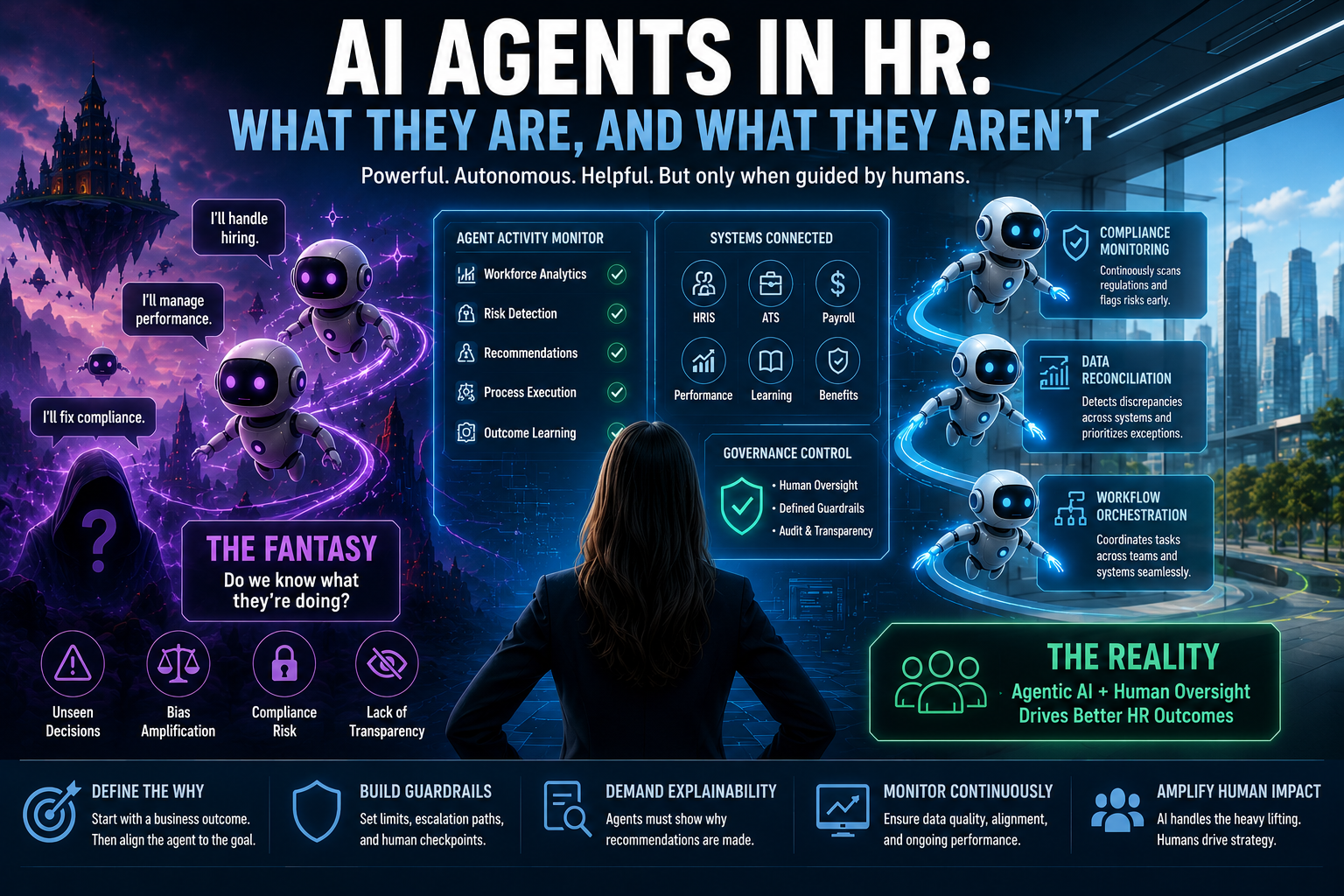
Artificial Intelligence is no longer a futuristic concept; it’s already shaping how HR teams recruit, develop, support, and retain talent. But as with any transformative technology, there’s significant confusion about what AI actually is in an HR context, especially when it comes to AI agents.
Understanding this distinction matters: the difference between a genuine autonomous assistant and a glorified automation can be the difference between strategic impact and wasted investment.
In today’s HR landscape, conversations often blur terms like “AI,” “chatbots,” “machine learning,” and “automation.” But beneath the hype lies a meaningful evolution worth understanding, especially for high-level HR leaders looking to scale responsibly and maintain employee trust.
Agentic AI vs. Traditional Automation: Clearing the Air
Most HR teams are familiar with traditional automation tools, macros in spreadsheets, rule-based workflows, chatbots that answer FAQs, or tooltips that suggest next steps. These technologies are useful, but they are reactive and static. They operate within tightly defined parameters and require explicit instruction.
AI agents, on the other hand, represent a shift toward autonomy, not human-like intelligence, but goal-oriented adaptability. In practical HR settings, an AI agent might:
- Monitor workforce analytics across your HRIS, ATS, payroll, and performance systems
- Detect patterns that indicate compliance risk, attrition risk, or talent gaps
- Recommend next steps based on historical data and defined goals
- Execute multi-step processes across systems- like scheduling interviews or provisioning equipment
This isn’t science fiction. Trend reports from HR thought leaders such as Gartner and Forbes highlight early enterprise use cases in which agent-based models support administrative recomposition, compliance monitoring, and cross-platform intelligence at scale.
What AI Agents Are
They are:
Autonomous within defined guardrails. They act toward goals without human prompts, but within oversight boundaries set by HR.
Context-aware across systems. They synthesize data from multiple sources to inform actions- not just respond to single inputs.
Adaptive over time. They learn from outcomes and refine recommendations in subsequent iterations.
What AI Agents Aren’t
They are not:
Magic replacements for human judgment. People's decisions still require context, empathy, and ethical oversight.
Simple chatbots or FAQ tools. Those are rule-based helpers, not autonomous actors.
Set-and-forget solutions. They thrive under governance, not in isolation.
In recent HR articles, including research from McKinsey and SHRM, analysts emphasize that the real value in AI comes when it augments human expertise, not substitutes for it.
The Risks HR Leaders Must Acknowledge
The biggest hazard isn’t deploying AI agents, it’s deploying them with overconfidence and under-investment in governance.
Forbes, Deloitte, and other leading voices in HR technology warn that agentic AI amplifies both efficiency and error if not designed with oversight. Misconfigured agents may:
- Misinterpret data relationships between systems
- Provide recommendations based on biased historical patterns
- Execute actions that create compliance risk
- Decrease transparency in decision logic
For example, an AI agent might automatically schedule interviews based on candidate scorecard data, but if the underlying scoring model contains bias, the agent simply accelerates inequity. Without clear human-in-the-loop checkpoints, an autonomous agent can create cascade effects that are difficult to trace.
Where AI Agents Add Real Value in HR
Used thoughtfully, AI agents can transform time-consuming processes into strategic assets:
Compliance Monitoring
Agents can continuously watch for regulation changes, flagging risk before it becomes a crisis, especially important in complex areas like ACA reporting, wage law compliance, and immigration status tracking.
Data Reconciliation
Instead of hours spent manually checking HRIS vs. payroll vs. benefits data, an AI agent can identify discrepancies quickly and prioritize exceptions for human review.
Workflow Orchestration
From onboarding checklists to exit interviews to internal mobility timing, agents can coordinate tasks across systems and teams, freeing HR for higher-value work.
These aren’t hypothetical experiments. Trend data from Deloitte’s annual Human Capital Trends report shows rising HR investment in AI technologies that improve speed and governance simultaneously. But the ROI depends on how you design the partnership between human and machine.
Humans Still Drive HR Strategy, AI Should Support It
HR leaders must avoid two extremes: fear-based rejection of AI or blind faith in it as a cure-all. The right strategy lies in a strategic partnership.
Here’s how forward-thinking teams approach AI agents:
1. Define Use Cases with Human Judgment First
Start with a business outcome (e.g., improve retention forecasting) and work backward to decide where automation vs. agent autonomy makes sense.
2. Build Guardrails Before Launch
Set thresholds for action, escalation paths, and human checkpoints so decisions aren’t made in a vacuum.
3. Make Explainability a Requirement
Agents should log why recommendations were made. Transparency isn’t just good practice; it’s essential for trust and compliance.
4. Embrace Continuous Monitoring
Like any system, agents need regular “health checks” to ensure data fidelity and alignment with evolving HR policies.
Agentic AI Isn’t the Future, It’s Today
For HR organizations, the strategic question is no longer should we adopt AI, but how do we adopt it responsibly and effectively? The goal isn’t automation for automation’s sake, but amplified human capability: faster operations without eroding trust, accountability, or culture.
When senior HR leaders understand the difference between intelligent support and autonomous oversight, they gain not just efficiency — they gain the capacity to focus on what HR does best: stewarding talent, driving culture, and enabling organizational success.
